


People often mistakenly believe that stiffness, catching, or pain in the elbow area will go away on its own and that no action is needed. However, Justinas Vaičiulis, an orthopedic traumatologist at the Orthopedics and Traumatology Center of Vilnius “Kardiolitos Clinics” says that ignored symptoms only worsen over time, and people risk their quality of life.
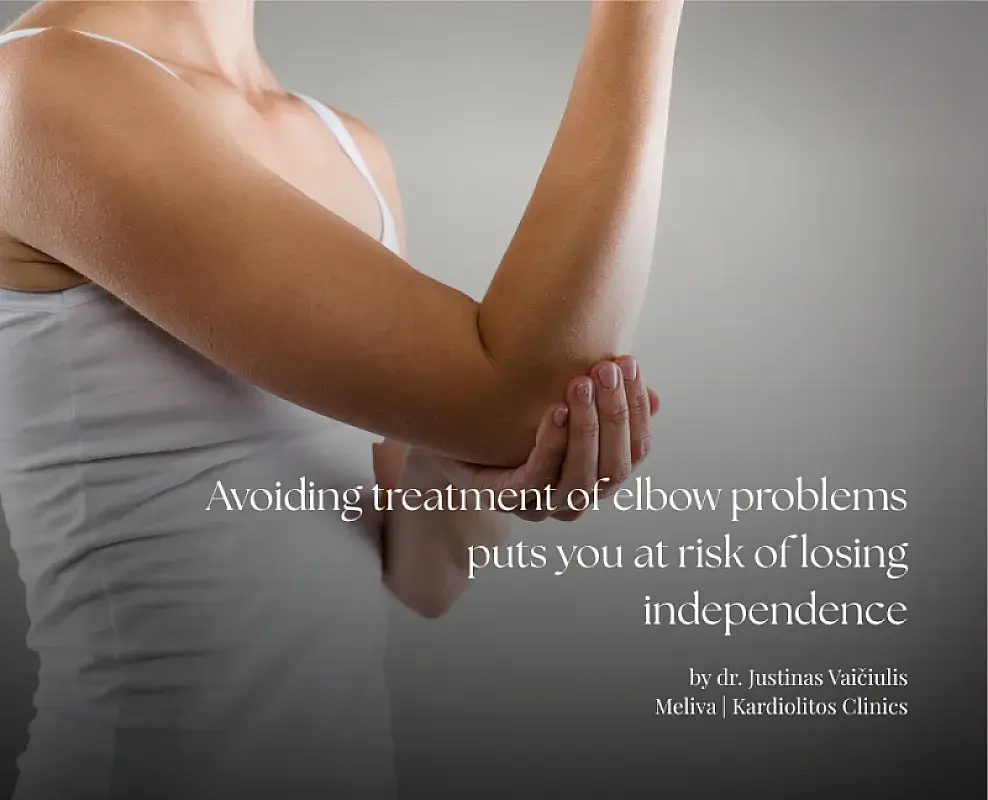
“People who experience pain, stiffness, or catching in the elbow but choose to ignore it risk facing serious long-term consequences that can significantly reduce quality of life and cause persistent discomfort. As time goes on and symptoms progress, a person may become unable to perform even the simplest actions: brushing their hair, eating independently, or getting dressed,” explains J. Vaičiulis.
What causes elbow problems?
The doctor from Vilnius “Kardiolitos Clinics” says that one of the most common elbow problems is joint contracture, which develops due to thickening of the joint capsule, causing a feeling of stiffness in the elbow joint and pain during movement. This problem is most often caused by prolonged post-traumatic inflammation, repeated injuries (often resulting from intense physical load or work), or long-term immobilization in a plaster splint (for example, after fractures of the humerus or forearm bones or other injuries), when the arm is not moved or when a person consciously avoids bending the elbow due to pain.
“The joint capsule can also thicken as a result of joint inflammation, in which case swelling, limited movement, and pain occur. During treatment, the inflammation may not be completely suppressed and does not fully resolve, so the thickened capsule remains, along with elbow flexibility problems. Due to elbow osteoarthritis or constant microtrauma, bony spurs may also form; these can break off and, floating freely in the joint fluid, cause a catching sensation and reduce the range of motion,” says the orthopedic traumatologist at “Kardiolitos Clinics,” where some of the best doctors in Lithuania work.
According to J. Vaičiulis, elbow catching can also be caused by osteochondritis dissecans-a pathology in which a piece of articular cartilage spontaneously separates due to impaired blood supply to the subchondral bone (the bone layer located directly beneath the joint cartilage). Elbow catching may also be caused by cartilage or bone fragments damaged by trauma, which form loose bodies in the elbow joint, also known as a “joint mouse.”
Conservative treatment is recommended first
“All patients suffering from pain, a catching sensation, or bending problems in the elbow area should immediately consult a doctor, who will determine the cause of the complaints, establish an accurate diagnosis, and prescribe appropriate treatment,” says the doctor from the Orthopedics and Traumatology Center of “Kardiolitos Clinics.”
According to J. Vaičiulis, when a person complains of stiffness in the elbow area due to post-traumatic consequences, conservative treatment is recommended first-intensive physiotherapy and/or individualized exercise programs.
“The elbow joint is difficult to restore in terms of range of motion, but with individualized and physiotherapy exercises the problem can be solved, provided especially important conditions are met-intensive patient involvement in the recovery process and strong determination. If the patient consistently follows the physiotherapist’s instructions and responsibly performs the required exercises, they can expect positive results and faster recovery. If conservative treatment does not help, we choose surgical treatment,” says the orthopedic traumatologist.
Arthroscopic elbow surgery
The doctor explains that arthroscopic surgeries address the causes of limited movement: degenerative damaged cartilage tissue causing catching is removed, the thickened capsule is released, loose bodies floating in the joint fluid are removed, as well as excessive bony growths (osteophytes) that formed after injuries.
“Arthroscopy is used to address impingement problems when a person cannot fully straighten or bend the arm, and also when it is necessary to release the joint capsule in the treatment of contracture,” says J. Vaičiulis.
According to the orthopedic traumatologist, arthroscopic surgery is a minimally invasive surgical treatment performed through very small incisions of about 0.5–1 cm in length. During the operation, an arthroscope (a small device with a video camera) is used, which allows examination of the elbow joint, assessment of pathology, and removal of the causes of movement problems.
“After surgery, the patient is transferred to the intensive care unit, where they are observed for several hours; later treatment continues in the hospital, but most often the patient can go home the day after surgery,” adds Justinas Vaičiulis, a doctor at Vilnius “Kardiolitos Clinics.”
People suffering from pain, stiffness, or catching in the elbow area should seek medical attention immediately, as ignoring the problem and avoiding treatment will not solve anything-on the contrary, symptoms will worsen, and eventually even the simplest daily tasks will become difficult.
Dr. Justinas Vaičiulis
Orthopedic traumatologist at Meliva | Kardiolitos Clinics